Greece Travel Guide 2026: Hidden Secrets Locals Wish You Didn't Know
Greece travel guide content has a problem: 95% of it steers you towards the same five destinations — Santorini, Mykonos, Athens, Rhodes, Corfu — then charges you €280 a night for the privilege of fighting 40,000 other visitors for the same photograph. This guide is different.
At TicketsHunters, our Greece travel guide is built with a single principle: honesty over hype, authenticity over algorithm. What follows is not a recycled listicle. It is a verified, data-backed, experience-built guide to the Greece that the tourism industry would prefer you never discover — because if you did, you would never pay €60 for a mediocre Oia restaurant again.
Why This Greece Travel Guide Starts Where Every Other One Ends
The fundamental flaw in mainstream Greece travel guide content is its obsession with photogenic over authentic. Santorini's caldera is genuinely beautiful — in a photograph. In reality, the famous sunset viewpoint at Oia has been legally limited to 1,500 visitors simultaneously since 2024, requires advance registration, and is flanked by €22-per-glass wine bars with queue times of 40 minutes. This is not a travel experience. It is a managed disappointment.
The real Greece this guide documents — the version that changes you — is found in the stone-arched villages of Zagori, the fishing harbour of Kastellorizo at 6am, the rooftop dinner in Folegandros's Chora where the taverna owner brings an unlisted dish because he noticed you were eating slowly and appreciating it. These are not difficult experiences to access. They simply require a guide that points in the right direction.
Greece in 2026: The Tourism Tipping Point
Greece's government introduced its Sustainable Tourism Framework 2025–2030 in response to record overtourism complaints from residents. Key 2026 changes that every traveller must know:
- Santorini cruise ship cap: Daily cruise passenger arrivals limited to 8,000 (down from 17,000+ in 2024). The island is still crowded in summer but significantly less chaotic.
- Acropolis timed ticketing expanded: All visits now require pre-booked time slots. Walk-up tickets are no longer available. Book through official channels at least 2 weeks ahead in peak season.
- New island incentives: Ferry subsidies on routes to 18 under-visited islands have reduced prices by 25–40%, making remote island travel more accessible than ever.
- ETIAS watch: The EU's ETIAS travel authorisation system for non-EU visitors is expected to launch in late 2026. Check current status via our verified VisaHQ review before booking.

The Hidden Mainland: Zagori, Pelion & Epirus
Greece's mainland is the most dramatically underestimated part of our Greece travel guide. While 93% of first-time visitors go straight to Athens then an island, the mainland hides some of the most spectacular and least-crowded landscapes in all of Europe. Three regions in particular deserve dedicated attention.
Zagori: Greece's Most Breathtaking Mountain Secret
Zagori (Ζαγόρι) — one of our Greece travel guide's top mainland picks — is a UNESCO-listed landscape of 46 stone villages connected by ancient kalderimi (cobblestone paths) and presided over by the Vikos Gorge — at up to 1,600 metres deep, one of the world's deepest gorges by depth-to-width ratio.
The signature experience: the Vikos Gorge traverse (approximately 12km, 5–6 hours) starts in Monodendri and ends in Papigo. En route, you cross three medieval stone bridges, pass through old-growth beech forest, and — if you are there in May or October — have an almost 50% chance of seeing wolf tracks in the trail mud. The nearest mass tourism is four hours away. This is the authentic Greece travel experience that no algorithm has yet monetised.
Pelion Peninsula: Homer's Mountain, The Centaurs' Trails
The Pelion Peninsula — a standout in any honest Greece travel guide — juts into the Aegean south of Thessaly and presents an almost impossible combination: dense chestnut and apple orchards on slopes that plunge directly into Aegean beaches. The villages — Makrinitsa, Vizitsa, Tsagarada — are stone-built, traffic-free and connected by ancient trails where, according to Greek mythology, the centaurs trained heroes including Achilles and Jason.
The seaside taverna at Damouchari (the small harbour featured in the film Mamma Mia!) is still largely unknown to international visitors despite its cinematic fame. A plate of freshly caught red mullet (barbouni) with local tsipouro costs €14. The same meal at a famous restaurant in Mykonos: €65.

Crete & the Peloponnese: The Greece Travel Guide's Most Misread Destinations
Crete is the most-visited Greek island — and the most misunderstood section of any Greece travel guide. Most visitors arrive in Heraklion and never venture past Elounda or Agios Nikolaos. This is a genuine tragedy, because the Crete that matters — the Crete that produces the world's best olive oil, whose cuisine forms the scientific basis of the Mediterranean diet, whose mountain villages still practise traditions unchanged for 500 years — begins where the tourist infrastructure ends.
Western Crete: Sfakia, the White Mountains and the Secret South Coast
The Sfakia region of western Crete is separated from the tourist north by the White Mountains (Lefka Ori) — a 2,400-metre massif crossed by the Samaria Gorge, Europe's longest gorge at 16km. The south coast villages of Loutro (accessible only by boat or foot), Agia Roumeli and Hora Sfakion operate on a different temporal logic: no cars in Loutro, no bank in Agia Roumeli, and a pride in self-sufficiency that dates from the Cretan resistance to Ottoman occupation.
The Sfakian hospitality rule: if a Sfakian restaurant owner brings you food you didn't order, eat it, thank them and do not ask the price. It will cost less than you expect and taste better than anything on the menu.

Nafplio: The Peloponnese's Perfect Secret Base
Nafplio is arguably — and this Greece travel guide stands firmly by the claim — Greece's most beautiful town that most international visitors have never heard of. Greece's first capital city after independence (1823–1834), it is a compact jewel of neoclassical architecture, Venetian fortifications and Ottoman fountains arranged on a small peninsula below the Palamidi fortress — 999 steps up, with views that silence even the most jaded traveller.
As a base for exploring the Peloponnese, Nafplio is unbeatable: Mycenae (45 min), Epidaurus (30 min), Ancient Corinth (90 min), the Mani Peninsula (2 hours), Olympia (3 hours). All within day-trip distance. A double room in a Nafplio boutique hotel in May: €75–110. In Santorini the same month: €280–450.
For self-guided exploration of the Peloponnese's ancient sites, Wegotrip's audio tour guides provide GPS-triggered professional narration at Mycenae, Epidaurus and Ancient Olympia — delivering expert context at your own pace without a group tour schedule.
Remote Islands: The Greece Travel Guide Secrets That Rarely Make Headlines
No Greece travel guide is complete without the island mathematics: Greece has 6,000 islands, of which 227 are inhabited. Of those, international tourism effectively concentrates on approximately 12. The other 215 inhabited islands exist in a parallel Greece — one where the ferry arrival is still a village event, where the taverna owner is also the fisherman who caught your dinner, and where the word “influencer” has no local translation.

Kastellorizo: Greece's Most Remote Inhabited Island
Kastellorizo (Castellorizo / Meis) sits 2.8km off the Turkish coast and 570km from Athens. With a permanent population of just 492 people, it is the smallest inhabited island in the Dodecanese. It has no airport (a small airstrip handles occasional light aircraft), one main harbour, one beach, and zero sunbed rental businesses — because the residents simply never got around to installing them.
The Blue Cave (Parasta Cave) — the island's geological centrepiece — is accessible only by small boat through a 1.2-metre-high entrance. Inside: a cathedral of turquoise light reflecting off the limestone ceiling. Entry requires a local boat operator and costs €10. The equivalent experience at Capri's Blue Grotto: €14 plus a 2-hour queue. At Kastellorizo: no queue, ever.
The Cyclades You Don't Know: A Greece Travel Guide to the Anti-Islands
The Cyclades form the most visually iconic chapter of any Greece travel guide. White cubes, blue domes, impossibly blue sea. The problem: the famous Cyclades — Santorini and Mykonos — have become parodies of themselves. Santorini's famous sunsets now require a 90-minute queue. Mykonos's party beaches cost €100 in sunbed hire before you order a drink.
The honest Greece travel guide answer: Naxos, Milos, Folegandros. Three islands within the same archipelago, a fraction of the crowds, and food, landscapes and experiences that consistently outperform their famous neighbours in independent traveller satisfaction surveys.
Naxos: The Anti-Santorini
Naxos is the largest and most self-sufficient Cycladic island. It produces its own cheese (graviera, a hard sheep cheese that beats most Swiss equivalents), its own potatoes (famous throughout Greece), its own marble, and its own sense of calm that resists being Instagram-formatted. The interior mountain villages — Apiranthos, Halki, Filoti — are virtually unknown to international visitors and require a rental car to access.
The Naxos marble quarry at Mount Kynthos contains an unfinished 6th-century BC kouros (youth statue) lying exactly where the ancient sculptors abandoned it. No fence, no ticket, no guided tour required. Walk to it, stand beside it, and contemplate 2,600 years of human ambition.
Pelion, Kefalonia & the Ionian Islands: Greece Travel Guide's Western Coast Revelation
The Ionian Islands are perhaps the most underrated section of this Greece travel guide: Corfu, Kefalonia, Lefkada, Zakynthos, Ithaca, Paxi — have a distinctly different character from the Aegean islands, shaped by their centuries under Venetian then British rather than Ottoman rule. The architecture is Italianate, the cuisine heavier and more herb-forward, and the landscape greener — these islands receive actual rainfall, an anomaly in the Greek summer.
Kefalonia: Beyond Captain Corelli's Beach
Kefalonia is famous for Myrtos Beach — one of the most photographed beaches in the Mediterranean. It is genuinely spectacular, and it is genuinely overcrowded in July and August. The Greece travel guide secret: Kefalonia's real treasures are underwater.
The sea caves of the Sami coastline — accessible by kayak from Antisamos Beach — include caverns illuminated by bioluminescent plankton after dark and shallow passages connecting open sea to hidden lagoons. Local operators charge €35–55 for a 3-hour guided kayak tour. This is the Kefalonian experience that no resort brochure features.
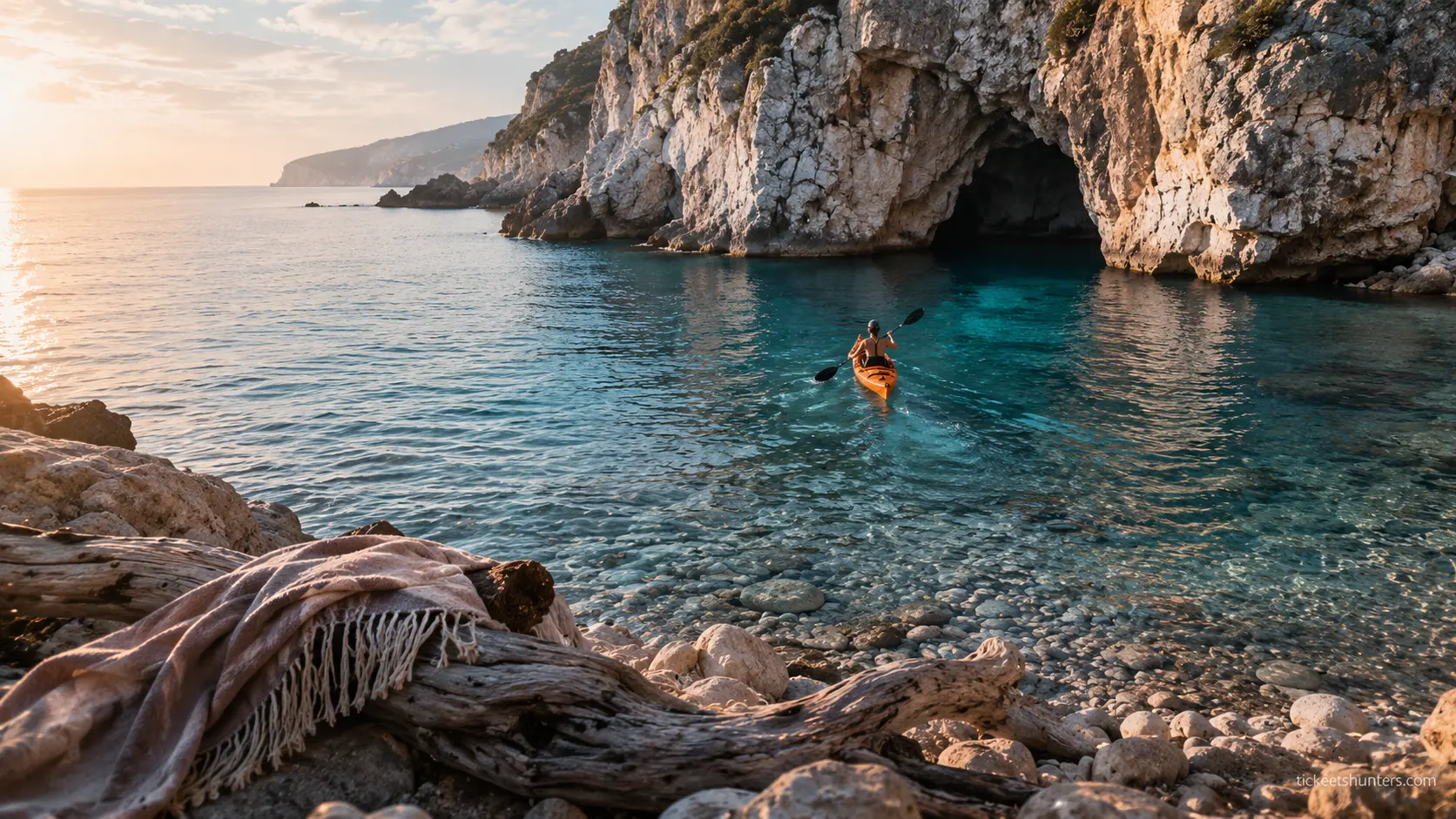
For Kefalonia and the Ionian Islands, a rental car is non-negotiable for accessing the sea caves, cliff-top monasteries and remote beaches. GetRentACar and QEEQ both offer the most competitive rates at Kefalonia Airport (EFL). For yacht access to the hidden sea caves, our Searadar yacht charter guide covers bareboat and crewed charter options from Argostoli harbour.
Folegandros & Symi: Europe's Most Underrated Island Experiences
Two islands consistently top TicketsHunters' “hidden excellence” internal rankings. Both are small, both are dramatically beautiful, and both have so far avoided the fate of their more famous neighbours. We include them in this Greece travel guide with ambivalence — because part of us wants to keep them secret, and the other part insists on our commitment to honest, complete information.
Folegandros: The Cliffside Chapel and the Road That Ends in the Sky
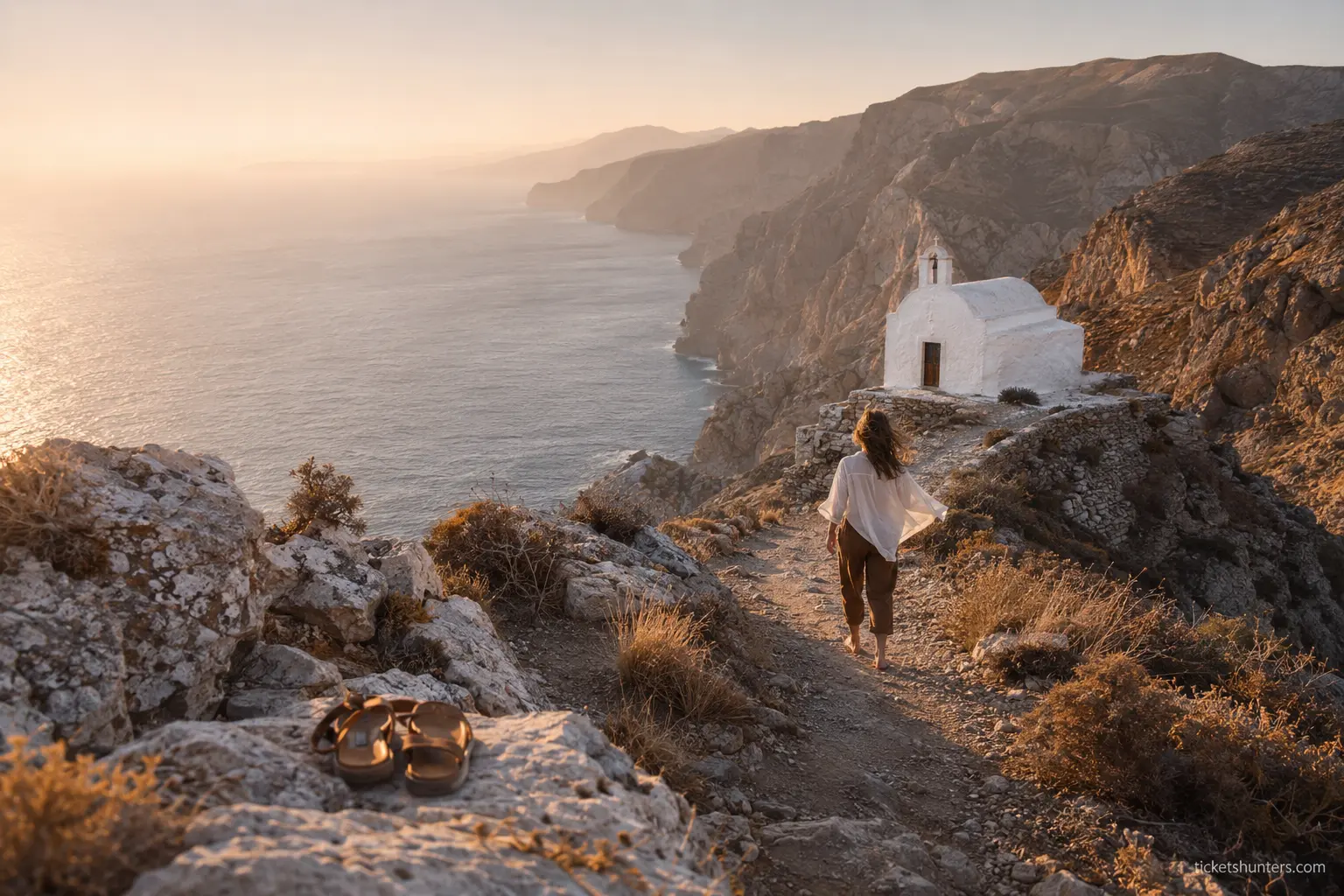
Folegandros is our Greece travel guide's single strongest off-the-beaten-path recommendation. It has no airport, no cruise ship dock, and a Chora (hilltop village) that is completely car-free and perched on the edge of a 200-metre cliff. The Church of Panagia, reached by a steep kalderimi path above the Chora, is where locals carry a 19th-century icon in procession every Easter — a ceremony that predates Greek independence and has never been interrupted, not even during the German occupation of 1941–44.
Symi: The Harbour That Time Forgot — Until 5pm
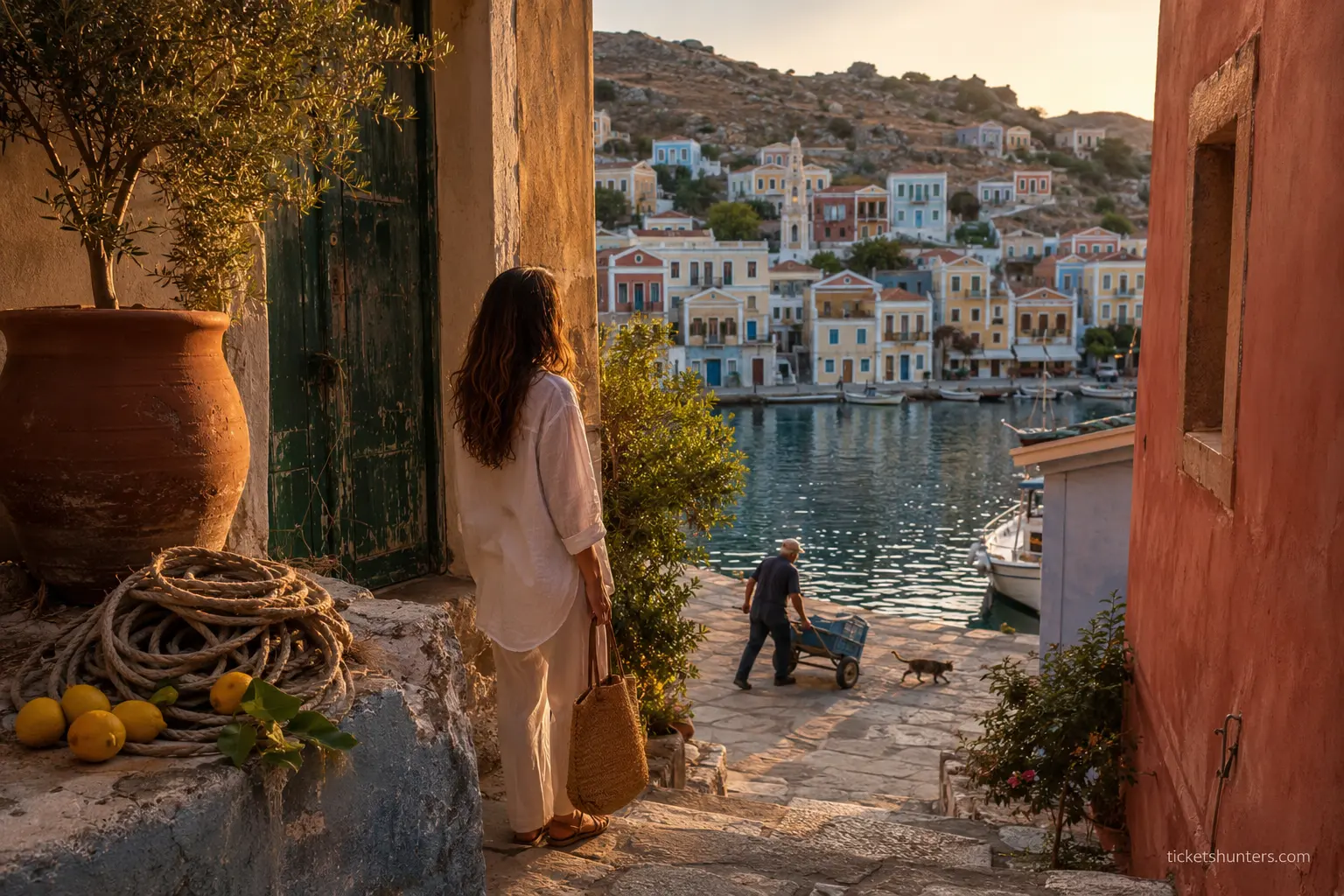
Symi belongs in every Greece travel guide — but for the right reason. Its neoclassical harbour — a tiered amphitheatre of ochre, terracotta and cream buildings ascending the hillside — is one of the most photographed harbours in the Aegean. The problem: day-trippers from Rhodes arrive at 10am and leave at 5pm. The solution: stay overnight. After the last ferry departs, Symi becomes an entirely different island. The narrow harbour alleys that were impassable at noon now belong entirely to the 3,000 permanent residents and the handful of overnight visitors wise enough to remain.
The Symi sponge diving tradition — the island was historically Greece's most important natural sponge harvesting community — is documented in the excellent Symi Museum and still practised in limited form by a handful of elderly divers. This is a living cultural heritage that no guidebook adequately covers.
How to Plan Your Greece Trip in 2026: The TicketsHunters Method
The most common Greece travel guide planning mistake: booking accommodation first, then building the itinerary around it. The correct method: decide your experience category first, then build outward. Here is the TicketsHunters framework for planning a Greece trip that actually delivers on its promise.
Greece Travel Guide: Best Time to Visit by Experience Type
| Month | Crowds | Prices | Best For | Avoid If |
|---|---|---|---|---|
| April | Low | 🟢 Lowest | Hiking, wildflowers, Peloponnese ruins | Swimming (sea cool: 17°C) |
| May ★ | Low–Med | 🟢 Low | Everything — the ideal month | Nothing significant |
| June | Medium | 🟡 Medium | Islands, beach, ferry travel | Peak-price events book up |
| July–Aug | Very High | 🔴 Peak | Parties, beach clubs, Mykonos | Authentic experience; value |
| September ★ | Low–Med | 🟢 Low–Med | Sea still warm, crowds gone | Some island businesses close late Sept |
| October | Low | 🟢 Very Low | Hiking, culture, food, wine harvest | Swimming (sea cools: 22°C) |
| Nov–Mar | Minimal | 🟢 Lowest | Athens, Thessaloniki, mainland | Most island businesses closed |
Getting Around Greece: The Honest Comparison
Ferry vs. Flight vs. Car vs. Yacht — Which Wins?
| Transport | Best For | Cost Range | Booking Lead Time | TicketsHunters Rating |
|---|---|---|---|---|
| Ferry (standard) | Island-hopping, atmosphere | €8–55 per leg | 3–4 weeks (summer) | ⭐⭐⭐⭐⭐ Best value |
| High-speed ferry | Time-limited travellers | €35–95 per leg | 1–2 weeks | ⭐⭐⭐⭐ |
| Domestic flight | Distant islands (Crete, Rhodes, Corfu) | €39–120 | 4–8 weeks | ⭐⭐⭐⭐ |
| Rental car | Mainland, Crete interior, Peloponnese | €22–60/day | 2–3 weeks | ⭐⭐⭐⭐⭐ Essential for mainland |
| Yacht charter | Remote coastline, sea caves, privacy | €800–3,500/week | 8–16 weeks | ⭐⭐⭐⭐⭐ Premium choice |
For car hire across all regions, DiscoverCars and AutoEurope provide the widest supplier network in Greece. For yacht charter, our in-depth Searadar yacht charter review reveals how to cut charter costs by up to 40% using bareboat positioning deals. For luggage-free island exploration, Radical Storage operates storage points at all major Greek ferry ports and airports.
Staying Connected in Greece: eSIM vs. Local SIM vs. Roaming
Connectivity across the Greek islands is uneven. Athens and major tourist islands have excellent 4G/5G coverage. Remote islands (Kastellorizo, Gavdos, Antikythera) have limited coverage from a single carrier. The smartest solution in 2026 is an eSIM — specifically configured for Greece with a multi-carrier backup. Our verified review of DrimSim's universal global SIM covers the best coverage for island-hopping itineraries, while Airalo's Greece eSIM provides the best price-to-data ratio for standard itineraries.
Greece Travel Guide 2026: Market Data, Pricing & Honest Comparisons
Greece Destination Comparison: The Numbers That Matter
| Destination | Avg. Hotel/Night (May) | Avg. Meal/Person | Ferry from Athens | Crowd Level July | TH Score |
|---|---|---|---|---|---|
| Santorini | €285–520 | €42–65 | ~€55 / 8h | 🔴 Extreme | 2.8/5 (value) |
| Mykonos | €320–600 | €55–90 | ~€48 / 5h | 🔴 Extreme | 2.5/5 (value) |
| Naxos ★ | €65–130 | €16–28 | ~€32 / 5h | 🟡 Medium | 4.8/5 |
| Folegandros ★ | €60–110 | €14–24 | ~€38 / 7h | 🟢 Low | 4.9/5 |
| Symi ★ | €70–140 | €18–30 | ~€45 / overnight | 🟡 Medium* | 4.7/5 |
| Kastellorizo ★ | €55–95 | €14–22 | ~€58 / 20h+ | 🟢 Very Low | 5.0/5 |
| Nafplio (mainland) | €75–120 | €18–32 | N/A (3h drive) | 🟢 Low | 4.6/5 |
| Zagori (mainland) | €55–100 | €14–22 | N/A (5h drive) | 🟢 Very Low | 4.9/5 |
*Symi: medium crowds during day from day-trippers; overnight visitors experience very low crowds after 5pm.
Greece Travel Guide: Honest Pros & Cons
✓ Why Greece Is Worth It
- 3,000+ islands — genuine variety for repeat visits
- Mediterranean diet — cuisine is extraordinary at every level
- Weather reliability — 300+ sunshine days per year
- Safety — consistently top 15 safest in Europe
- History density — more UNESCO sites than most countries
- Shoulder season value — Europe's best price/experience ratio in May
- Local hospitality — genuine, unhurried, generous
✗ The Honest Downsides
- Peak season overtourism severe in top 8 destinations
- Ferry strikes can disrupt island plans (rare but real)
- Meltemi winds (July–August) can cancel ferry routes for days
- ATM availability zero on smallest islands
- ETIAS may add admin overhead from late 2026
- Some remote islands: internet remains 3G
What This Greece Travel Guide Recommends for Every Travel Style
Solo Adventurer
Kastellorizo → Symi → Folegandros. 3 islands, 14 days, zero crowds, maximum authenticity.
Romantic Couple
Nafplio → Pelion → Symi. Culture + nature + harbour magic without Santorini prices.
Family
Kefalonia → Naxos. Sea caves + safe beaches + pasta-making + ruins kids can actually climb.
Hiker / Active
Zagori (Vikos Gorge) + Crete (E4 trail). Europe's most dramatic hiking outside the Alps.
Food Traveller
Pelion + Crete interior. Greece's most serious food production zones, both criminally undervisited.
Yacht Charter
Dodecanese circuit: Rhodes → Symi → Tilos → Kastellorizo → Kalymnos → Kos. 2 weeks, 6 islands.
Greece Travel Guide 2026: Complete Planning Toolkit
| Travel Need | TicketsHunters Recommended Tool | Why It Matters for Greece |
|---|---|---|
| Car Hire | DiscoverCars / AutoEurope | Essential for Peloponnese, Crete interior, Zagori, Pelion |
| Audio Tours | Wegotrip | Acropolis, Mycenae, Epidaurus — expert narration, your own pace |
| Guided Tours | GetYourGuide | Snorkelling, kayak caves, island food walks, cooking classes |
| Yacht Charter | Searadar | Dodecanese, Ionian and Cyclades bareboat & crewed charters |
| Visa / ETIAS | VisaHQ | ETIAS expected 2026 — check requirements before booking |
| eSIM / Data | Airalo / DrimSim | Multi-island connectivity; Airalo for budget, DrimSim for remote islands |
| Luggage Storage | Radical Storage | Ferry port storage — explore Athens or Piraeus bag-free |
| Holiday Package | CHECK24 | Flight + hotel bundles for Crete, Rhodes, Corfu at best combined rates |
| Events / Shows | TicketNetwork | Athens Epidaurus Festival, summer concerts at ancient theatres |
Greece Travel Guide FAQ — Every Question, Answered Honestly
TicketsHunters Final Verdict: The Greece That Awaits You Has Never Been in a Brochure
Every year, millions of people visit Greece and leave vaguely disappointed. They have seen the photographs. The reality — crowded, expensive, algorithmically optimised — did not match. This is not Greece's fault. It is the fault of the tourism industry that funnels visitors into a tiny fraction of what Greece actually offers.
The Greece of this guide — Zagori's wolf-patrolled gorges, Kastellorizo's bioluminescent cave, the 6pm silence of Symi harbour, Folegandros's untranslated menus — this Greece is not difficult to reach. It simply requires the honest guidance to point you there.
At TicketsHunters, honesty is not a policy. It is the architecture. Use this Greece travel guide as your foundation, use our verified tools as your infrastructure, and trust the empty cove over the influencer recommendation every single time.
Disclosure: This article contains affiliate links. TicketsHunters may earn a commission at no additional cost to you when you book through our partner links. All destinations, rankings and data are based on independent editorial research — no placement fees accepted. | Last Updated: 26 May 2026 | Author: TicketsHunters Travel Research Team